





Shoulder, Knee and Ankle Injuries
Shoulder Injuries
The shoulder includes two joints:
- the joint between the collarbone and the shoulder blade, called the acromioclavicular joint
- the joint between the upper arm bone and the shoulder blade, called the glenohumeral joint
All the muscles that perform the movements of the shoulder are called the rotator cuff.
A shoulder injury involves:
- an articular component, meaning a mechanical blockage in one or both of the shoulder joints.
- a tendinous and muscular component, meaning tendinitis of one or more tendons of the rotator cuff muscles.
This type of injury appears following an accident, repeated or very intense muscular efforts, or repeated aggressive postures.
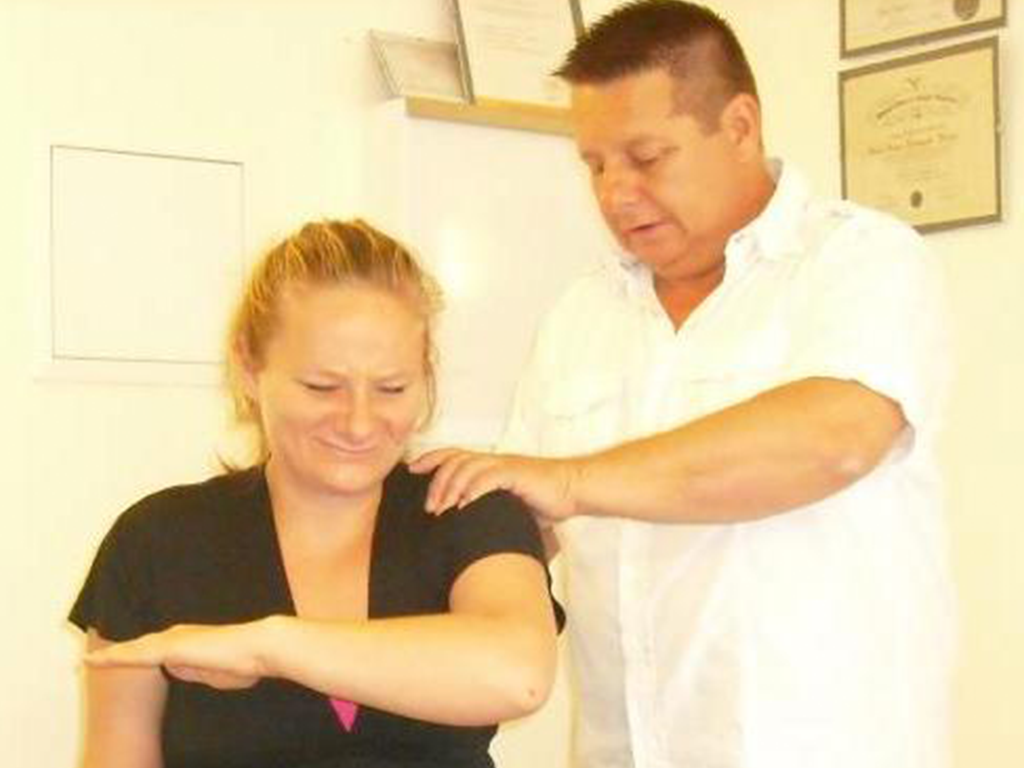
To properly diagnose a shoulder injury, a series of shoulder X-rays and an ultrasound of the shoulder tendons must be performed. The chiropractor evaluates the shoulder injury, on one hand, by having the patient perform certain shoulder movements, and on the other hand, by palpating the involved joints and tendons.
When symptoms radiate down the arm or forearm, a differential diagnosis must be made between a cervicobrachial lesion and periarthritis of the shoulder. The former is associated with a cervical disc lesion, whereas the latter is specific to the shoulder
Chiropractic treatment
It consists of two parts:
- Joint unlocking and recentering through compression on the restricted area while the patient moves their arm in different directions
- Treatment of the rotator cuff lesion using the instrument-assisted scraping technique (the Myo-Dren blade) covered in the chapter "Treatment of soft tissue lesions".
It takes 3 to 7 sessions spread over 1 to 3 months to treat a shoulder lesion.
Knee Injuries
The knee includes 4 bones (femur, patella, tibia, and fibula), 2 cartilages (internal and external menisci), and 3 joints:
- patellofemoral
- tibiofemoral
- tibiofibular
Pathologies are diverse: cruciate ligament tears, cartilage wear (osteoarthritis), meniscal fissures or tears, mechanical blockages, and tendinitis. Chiropractic care can address the last two pathologies: blockages and tendinitis.
Knee injuries appear following an accident, or the practice of certain sports (skiing, tennis, hiking, rebound sports...).
When pain extends beyond the knee area (pain in the thigh and calf), a differential diagnosis must be made between a radicular lesion (sciatica or cruralgia with painful radiation down the leg, particularly at the knee) and a primary knee injury. The radicular lesion originates from a lumbar disc herniation (see chapter 'Disc Lesions').
The examinations used to diagnose a knee injury are X-rays and a CT scan or MRI of the knee. The examination used to diagnose sciatica or cruralgia is a lumbar MRI or CT scan. In addition to X-rays, CT scans, and MRIs,
The chiropractor will diagnose a joint or tendon injury of the knee by having the patient perform specific movements and by palpating the involved joints and tendons.
Chiropractic Treatment
Chiropractic treatment will address different joints.
- On the tibiofemoral joint, the procedure is as follows:
- Unlocking and recentering of the tibiofemoral joint by applying compression to the restricted area while the seated patient performs leg rotation movements as well as flexion-extension movements of the leg on the thigh.
- Treatment of any associated tendinitis using the instrument-assisted scraping technique (the Myo-Dren blade) covered in the chapter "Treatment of Soft Tissue Injuries."
- On the tibiofibular joint:
- Unlocking the articulation by applying compression to the fibula while the patient, lying prone (on his stomach), performs inward and outward foot rotation movements.
Treatment and Session Frequency:
2 to 5 scheduled sessions with a 10-day interval between each.
Ankle and Foot Injuries
The foot has 26 bones, 16 joints, 107 ligaments, and 20 intrinsic muscles. The main injuries of the foot and ankle include frequent trauma, joint wear, and morphological deformities.
Chiropractic treatment
Before deciding whether a foot condition can be treated, X-rays of the foot are needed to check for fractures, and possibly a CT scan to diagnose a Lisfranc injury or an MRI to look for a Morton's neuroma.
The chiropractor can treat:
- ankle sprains
- joint tensions of the malleoli relative to the astragalus (also called the talus), the calcaneus (heel bone) relative to the astragalus, the cuboid relative to the calcaneus and the fourth and fifth metatarsals
- Achilles tendinitis and plantar fasciitis. (see Tendinitis window)
Treatment can last from 1 to 3 months, and the number of sessions varies from 2 to 7 depending on the severity of the injury.