





Disc Lesions
In 2017, Alain Dhers created the discal recentering technique which states that spinal subluxations and their nerve consequences are caused by lesions or tears of the intervertebral discs and not by vertebra blockages.
Therefore, discal lesions (disc protrusions and herniations) are responsible for the following conditions:
- Chronic lower back pain and acute lower back pain (lumbar blockage)
- Sciatica
- Cruralgia
- Maigne’s syndrome
- Pain and visceral disorders
- Back and rib pain
- Neck pain
- Cervicobrachial neuralgia (arm pain originating from the neck)
Let's elaborate
Lumbago = lumbar subluxation caused by a discal lesion, but without root involvement, meaning without compression of the torn disc on a nerve — therefore without pain in the legs.
Sciatica = is a lesion caused by a lumbar disc protrusion or herniation compressing one of the 2 nerve roots of the sciatic nerve and causing acute pain along all or part of the back of the leg. This involves a lesion of one of the last 2 lumbar discs: L4-L5 and L5-S1.
Cruralgia = is a lesion caused by a lumbar disc protrusion or herniation compressing one of the 3 nerve roots of the femoral nerve and causing acute pain in the groin and on the front of the thigh. This involves a lesion of one of these three lumbar discs: L4-L5, L3-L4, and L2-L3.
Maigne's syndrome = is a lesion caused by a lumbar disc protrusion or herniation at the T12-L1 disc level. This compression causes referred pain in the lower lumbar region, the side of the hip, and the groin, as well as visceral pain, often intestinal.
Upper back pain, rib pain = subluxation of a dorsal vertebra caused by a dorsal disc lesion, with or without radiation along one of the two ribs joined to this vertebra.
Neck pain or cervical sprain = subluxation of a cervical vertebra caused by a cervical disc lesion without compression of the arm nerves.
Cervicobrachial neuralgia is a lesion caused by a cervical disc protrusion or herniation compressing one of the arm's nerve roots and causing acute arm pain and hand numbness.
-
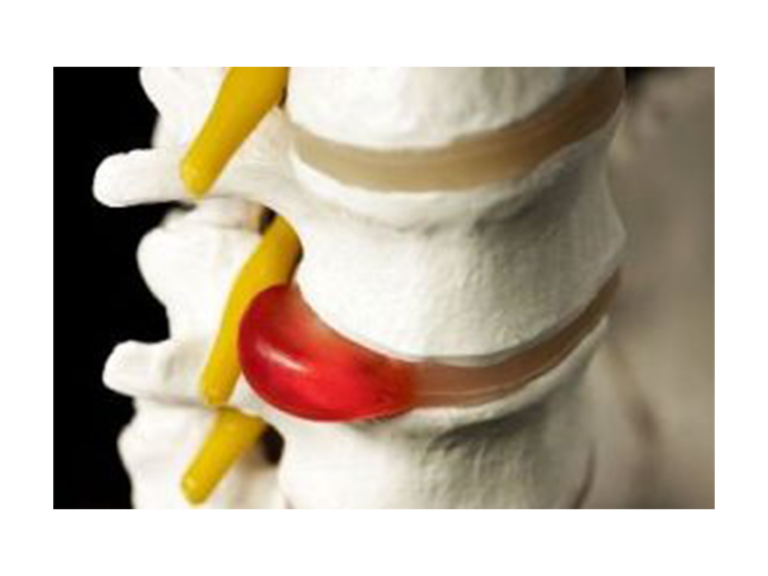
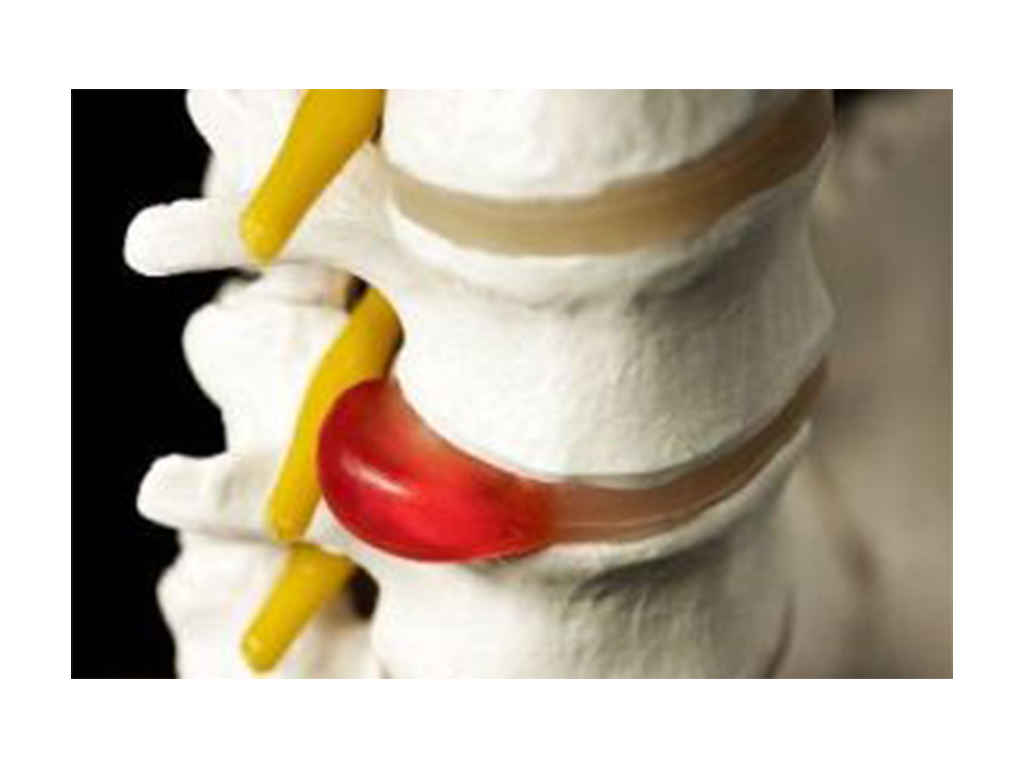
- Herniated disc with compression on a nerve (in yellow)
-
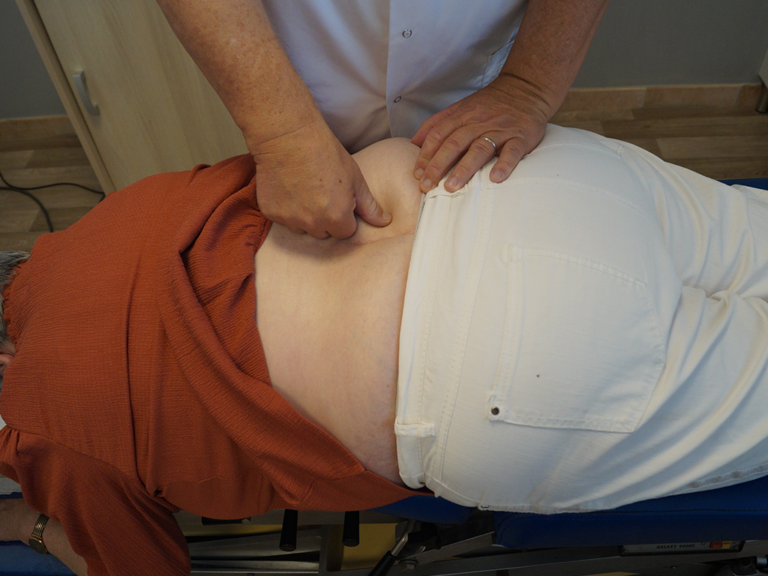
- Treatment of a cervical disc hernia
-
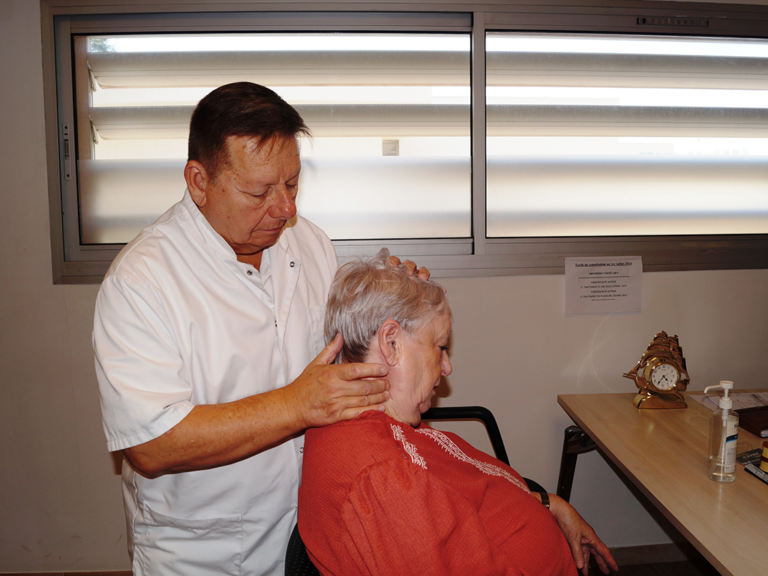
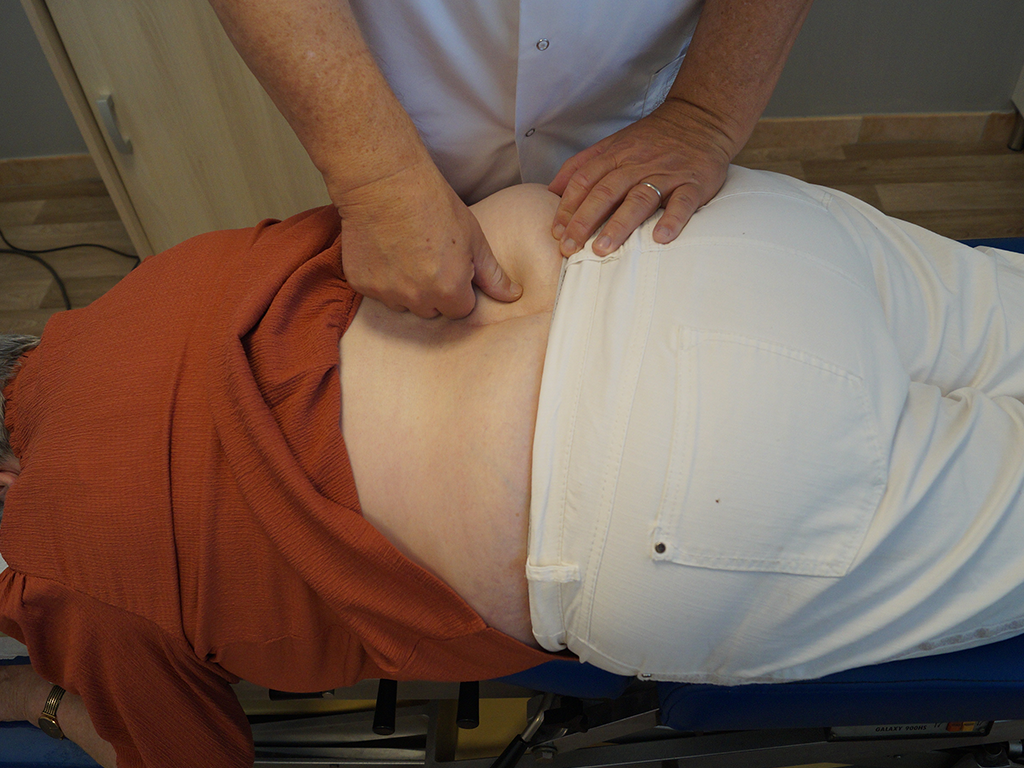
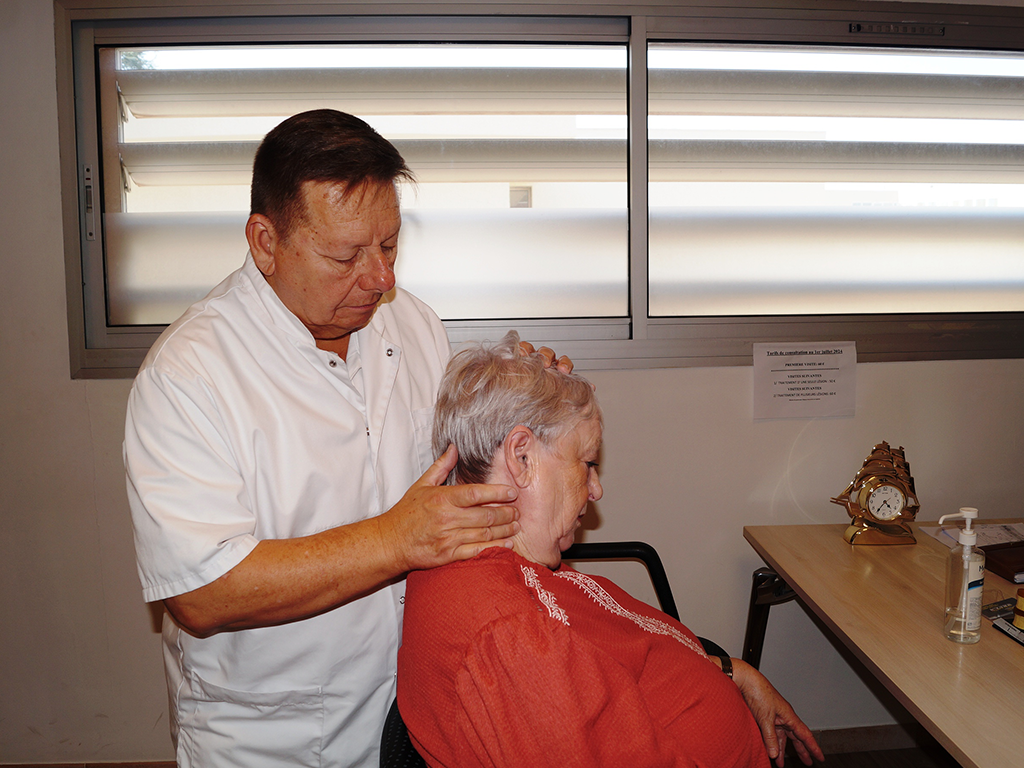
- Treatment of a cervical disc lesion
Causes of these lesions
At the lumbar level, these lesions are caused by repeated postures that strain the lumbar discs (forward bending, gardening, lifting heavy objects, sports, etc.).
At the dorsal level, these lesions are caused by repetitive rotational movements in a professional, sports, or accidental context.
Cervical spine injuries can be caused by trauma (such as car accidents or whiplash) or repetitive postures in professional settings ( like hairdresser, dentist or computer user, etc.) or sports .
How a disc lesion forms
Intervertebral discs lie between the vertebral bodies and form the main joint between the vertebrae. The first disc is located between C2 and C3, and the last one between L5 and S1. A disc consists of a central nucleus that acts as a joint pivot and shock absorber between the vertebrae, and a peripheral ring made of very strong crossed connective fibers whose function is to encapsulate and keep the disc centered.
A disc lesion occurs when there is a partial tear of the peripheral ring, following sudden joint trauma or repeated postural micro-traumas, and gravity pushes the nucleus toward the open breach in this peripheral ring. As it does so, the off-center disc nucleus takes the vertebra it supports along with it, shifting it relative to the other vertebrae: this is called a vertebral subluxation. This off-centering of the nucleus can go as far as compressing adjacent nerve structures. This explains the pain felt in the legs (sciatica, femoral neuralgia, etc.) or in the arms (cervicobrachial neuralgia).
Chiropractic treatment
Before treating these disc-related lesions, it is very helpful to review spinal X-rays as well as a CT scan or MRI of the affected area to locate the disc lesions.
Next, the chiropractor will perform specific tests and palpate the suspect disc areas to identify the disc causing the patient's condition. Finally, he will realign the disc using a manual compression technique. This realignment centers and unlocks the vertebra supported by the injured disc. It also relieves pressure on the adjacent nerve structures and eliminates the associated symptoms (such as sciatica ...).
It takes 2 to 3 sessions spread over 1 to 3 weeks to treat lumbago or a stiff neck, with a one-week spacing between each session.
It takes 3 to 6 sessions spread over 1 to 3 months, with an initial one-week spacing between each session, to treat sciatica, cruralgia, or cervicobrachial neuralgia.
To treat a lumbar, dorsal or cervical disc lesion, the chiropractor does not crack the neck, the dorsal vertebrae or the lower back.