





Occipital Neuralgia (Arnold's neuralgia), Migraines and Dizziness
Occipital Neuralgia (Arnold's neuralgia)
Occipital neuralgia is a nerve injury affecting the occipital nerve. It causes an intense, barely bearable painful sensation, resembling a burning feeling or an electric shock along the nerve pathway. It originates at the back of the skull in the occipital region and radiates either over the top of the head to the back of the eye, or toward the ear. It is associated with cervical and occipital stiffness, as well as limited head mobility during extension and rotation.
It is caused by the irritation or compression of the greater occipital nerve and/or the lesser occipital nerve, both commonly referred to in French as "the Arnold's nerves". These nerves originate from the C2 and C3 cervical nerve roots, which exit the spinal cord between the 1st and 2nd cervical vertebrae (C2 root) and between the 2nd and 3rd cervical vertebrae (C3 root), respectively. This condition is usually affecting only one side. It is frequently confused with migraines.
Chiropractic Treatment
X-rays, a CT scan, or an MRI of the cervical region must be performed to complete the examination and potentially diagnose specific underlying conditions.
Then the chiropractor must identify and reduce the compressions exerted by joint and muscle structures located along the nerve pathway. Specifically, these include the C2-C3, C1-C2, and occipito-atlantal (occiput-C1) joints, as well as the sub-occipital muscles.
Chiropractic treatment:
Treating Occipital Neuralgia typically requires 2 to 5 sessions spread over 1 to 3 months, with a one-week interval between each session at the beginning of the care plan.
Migraines and Headaches
The causes of these conditions are numerous. They can be serious (such as a brain tumor), linked to the menstrual cycle in women, or even result from vision problems.
However, the most common cause is a cervical vertebra subluxation. This subluxation reduces neck mobility and can compress one of the vertebral arteries which travel up inside the vertebrae to supply blood to part of the brain. If one of these arteries is compressed, blood flow to the brain is reduced, which can cause the following symptoms: headaches, migraines, dizziness, mental confusion, difficulty concentrating, eye strain, and sleep disturbances.
Chiropractic Treatment
First, X-rays and a CT scan or MRI of the cervical area are necessary to look for joint conditions and potential disc lesions.
Next, the chiropractor will identify and locate the subluxated cervical vertebra causing the compression on the vertebral artery. The chiropractor will thenadjust this vertebra using the disc centering technique (see the "Disc Lesions" section).
This action restores joint mobility in the neck, improves blood flow through the vertebral arteries, and eliminates headaches along with other associated symptoms.
Treating a migraine typically requires 3 to 6 sessions spread over 1 to 3 months, with a one-week interval between sessions at the start of the treatment.
Dizziness (Vertigo)
There are different types of vertigo:
- Meniere's disease: a condition affecting the entire membranous labyrinth of the inner ear.
- Benign paroxysmal positional vertigo (BPPV): a condition affecting the vestibular system of the inner ear.
- Cervicogenic vertigo: vertigo originating from the cervical spine.
A chiropractor can treat the last two types: benign paroxysmal positional vertigo (BPPV) and cervicogenic vertigo.
Causes of vertigo treated by a chiropractor
1. Benign Paroxysmal Positional Vertigo (BPPV):
This is a brief episode of vertigo triggered by head movements. It is caused by the displacement of tiny crystals inside the inner ear. This type of vertigo can occur as a result of:
- Aging: the most common cause.
- Head trauma.
- Ear infections or conditions: such as otitis, labyrinthitis, or vestibular neuritis.
- Prolonged immobilization: being bedridden for a long time, for example, after surgery.
Treatment of BPPV:
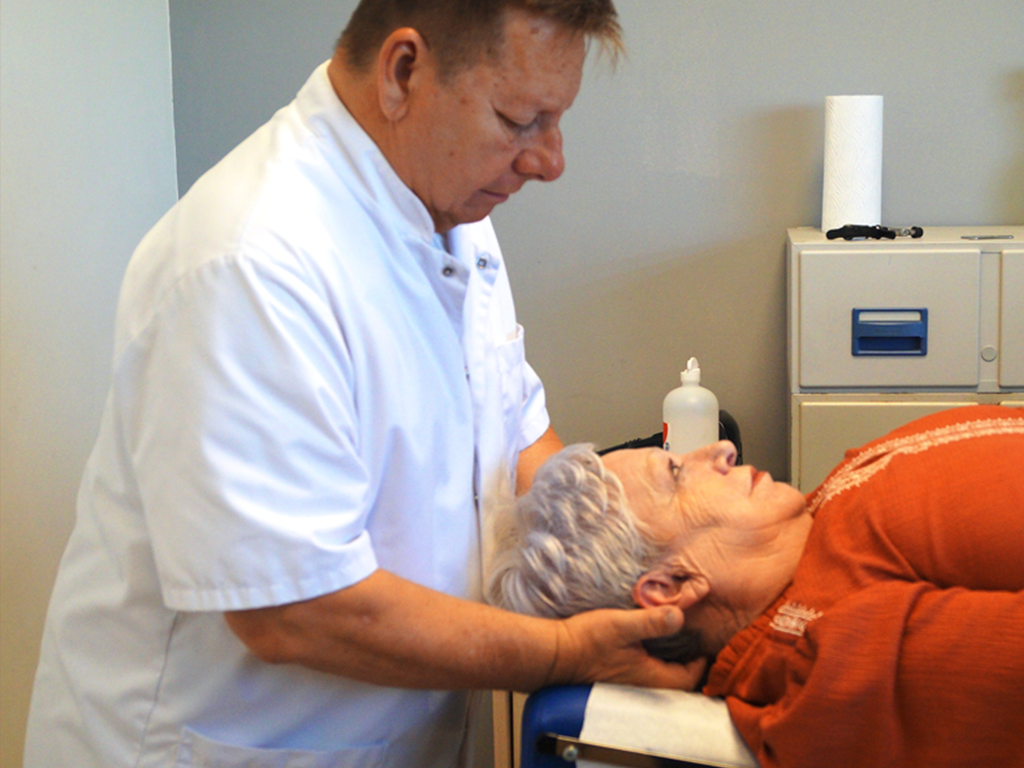
It is treated using the Epley maneuver. This is a painless cervical mobilization performed by a chiropractor to guide the displaced inner ear crystals back into place.
2- Just like cervicogenic headaches, Cervicogenic Vertigo can be caused by trauma (such as whiplash from a car accident) or linked to postural strain in the neck. These events create a cervical blockage that reduces neck mobility on one hand, and decreases blood flow to the brain on the other—flow that is supplied by the cervical arteries running inside the vertebrae. This reduced blood flow is the cause of the vertigo.
Chiropractic treatment for cervical vertigo: It is the same as the treatment for migraines. It therefore consists of unlocking the vertebra responsible for the vertigo.
Frequency of sessions: 3 to 6 sessions scheduled with a one-week interval between each at the start of treatment.
To treat Occipital neuralgia, Headaches, or Dizzinss, Mr. Dhers does not crack cervical vertebrae.